









Real student clicks from 159 UK institutions show why GCSE results day sparks three times more activity among students exploring a Sixth Form route.
GCSE Results Day is one of the biggest moments in the student calendar. Grades land, options get confirmed, and thousands of 16 year olds start planning their next move, all in the space of a few hours.
But "next move" doesn't mean the same thing for everyone. For students heading into Sixth Form, Results Day is the moment A Level choices get locked in. For students heading down a vocational route, that decision is often already made. Same day, very different stakes.
Our Pathways One data backs this up, and the gap is bigger than we expected.
Across all 159 institutions using Pathways One, Results Day 2026 saw over 450,000 views of occupations, where a normal day sees around 60,000. That's the scale of the moment before we even start splitting the data apart.
Across these 159 institutions, we compared views per site on Results Day against an average day over the previous six months.
Sixth Form colleges
20×
vs
Non-sixth form
6.7×
Sixth Form colleges saw views jump by as much as 20 times their normal daily average. Non-Sixth Form sites, including FE colleges, schools, and training providers, saw a rise too, but a far smaller one: 6.7 times.
Put simply: those exploring a Sixth Form route respond in far greater numbers. But as we'll see later in this article, those exploring FE and vocational routes show a real shift too, including a notable move towards more academic occupations. The difference isn't whether students react, it's the scale of that reaction.
The professions that were already there, and the ones just arriving
Last year's Results Day report flagged a clear pattern: students get more ambitious on the day itself, with professional and high-prestige careers like legal and biomedical science surging into view.
That pattern held again this year:
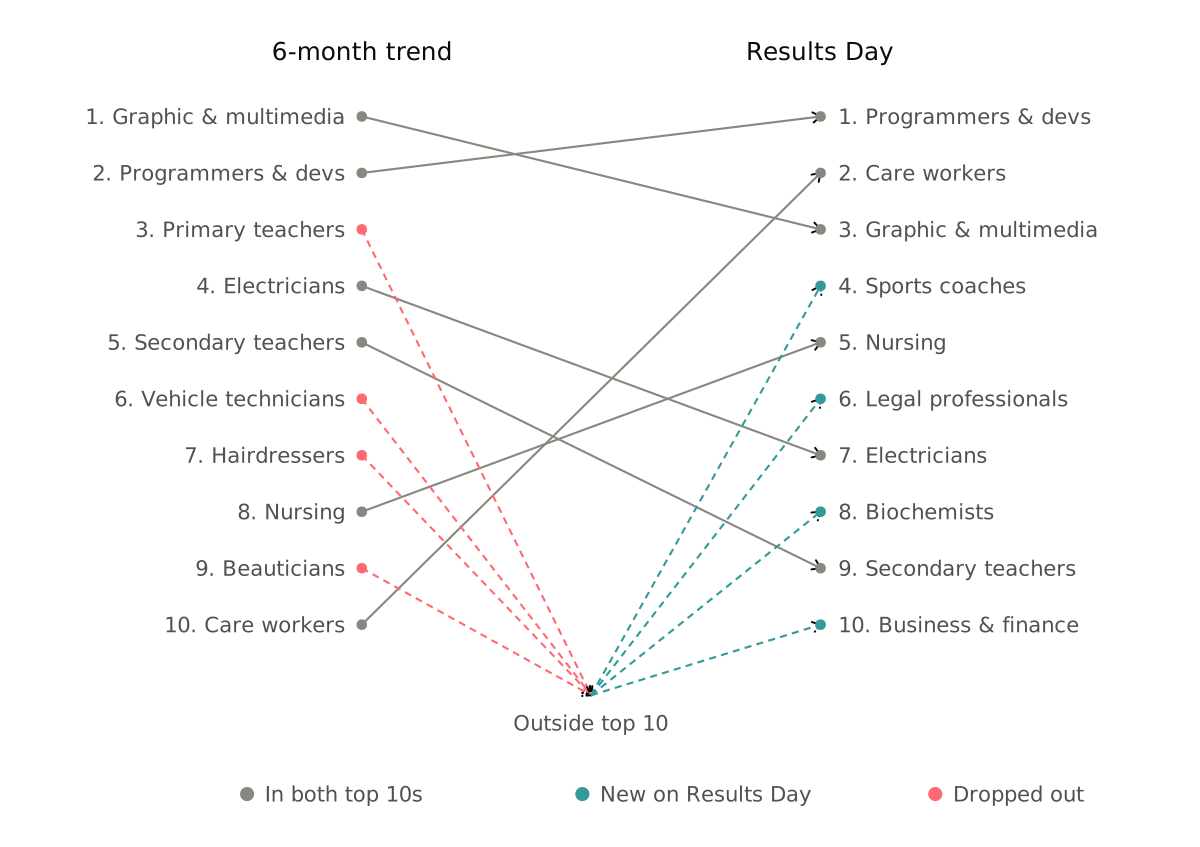
This time, we wanted to understand what was actually driving it, so we split the data by institution type - Sixth Form colleges versus everyone else (FE colleges, schools, and training providers) - to see what was underneath.
Here's how the top 10 occupations compared on Results Day:
| # | Sixth Form | Non-sixth form |
| 1 | Programmers and software development professionals | Programmers and software development professionals |
| 2 | Legal professionals | Care workers and home carers |
| 3 | Care workers and home carers | Graphic and multimedia designers |
| 4 | Secondary education teaching professionals | Electricians and electrical fitters |
| 5 | Generalist medical practitioners | Sports coaches, instructors and officials |
| 6 | Graphic and multimedia designers | Nursing professionals |
| 7 | Educational support assistants | Engineering technicians |
| 8 | Police officers (sergeant and below) | Biochemists and biomedical scientists |
| 9 | Sports coaches, instructors and officials | Business and financial project management professionals |
| 10 | Biochemists and biomedical scientists | Animal care services occupations |
Legal professionals sits comfortably in the Sixth Form top 10, at rank 2, but is absent from the non-sixth form top 10 entirely. Biochemists and biomedical scientists appears in both lists, at similar positions (10th and 8th), but as we'll see, the two rankings arrived there in very different ways.
To understand what's behind that, we looked at where these careers ranked over the previous six months against where they landed on Results Day. That's where the two institution types tell genuinely different stories.
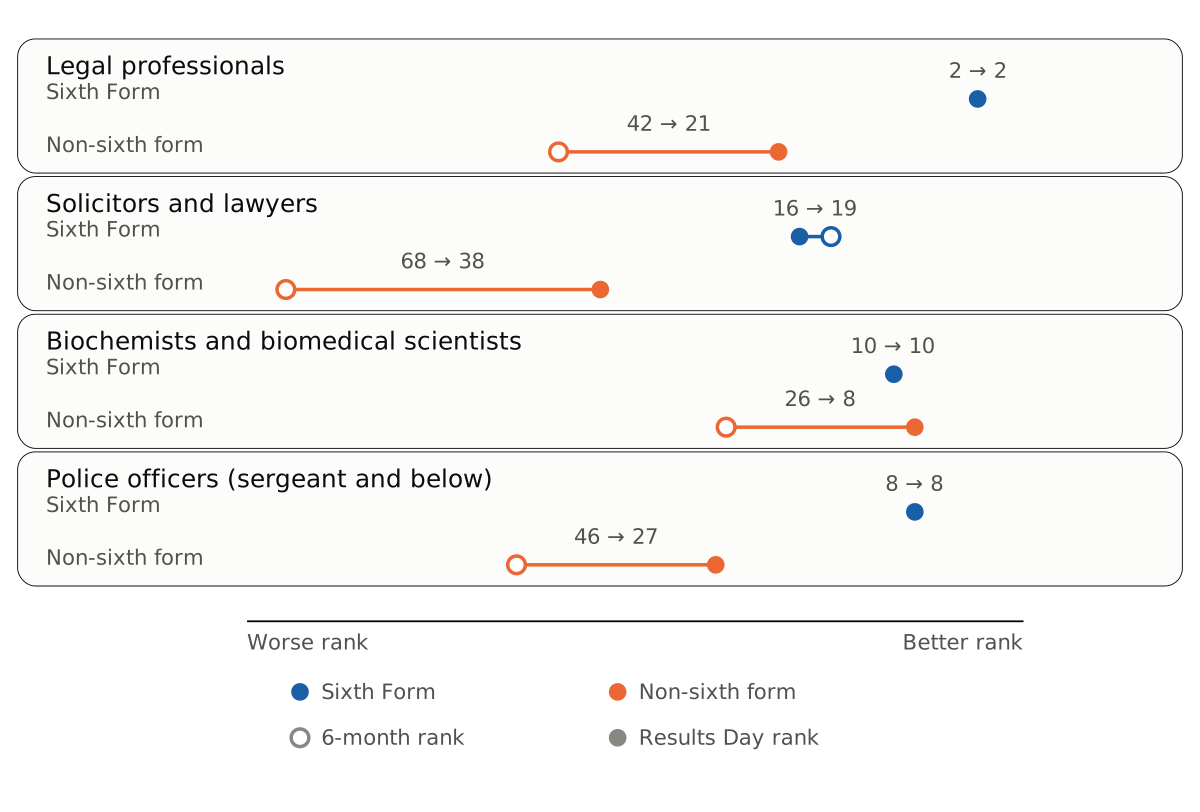
In Sixth Form colleges, these roles barely moved. Legal professionals held at rank 2. Biochemists held at rank 10. Police officers held at rank 8. They were already established, everyday choices for students exploring this route, so Results Day didn't need to introduce them.
In non-sixth form settings, the same roles moved sharply. Legal professionals jumped from 42nd to 21st. Solicitors and lawyers climbed from 68th to 38th. Biochemists and biomedical scientists rose from 26th to 8th.
This adds real depth to last year's headline finding. The surge towards prestigious, professional careers on Results Day is still there, but it's largely driven by students exploring vocational pathways discovering these roles for the first time on the day. Students exploring a Sixth Form route aren't becoming more ambitious on Results Day so much as arriving at it already set on these routes.
A shared pull towards professional and technical roles
Strip out the headline names and look further down the list, and the same direction of travel shows up in both segments at once. A cluster of professional and technical occupations rose in rank on Results Day, regardless of institution type.
IT operations technicians, civil engineers, mechanical engineers, laboratory technicians, and finance and investment analysts all climbed in both Sixth Form and non-sixth form data.
The scale varies occupation by occupation, and non-sixth form movement is often the larger of the two, but the direction is consistent throughout. Even in a segment where Results Day drives a smaller overall surge, the interest that does shift still tilts towards professional and technical routes, just as strongly as it does in Sixth Form.
Subjects: a story that needs the split
Subject data doesn't lend itself to a single top 10 comparison the way occupations do. Sixth Form subject views are dominated by A Levels; non-sixth form views are dominated by vocational course categories. That's expected, and not especially interesting on its own. Here's what the Results Day top 10 looked like for each:
| # | Sixth Form | Non-sixth form |
| 1 | A Level Psychology | Electrical |
| 2 | A Level Biology | Health & social care |
| 3 | A Level Sociology | Engineering |
| 4 | A Level Mathematics | Vehicle maintenance |
| 5 | A Level Business | Beauty therapy |
| 6 | A Level Law | Business professional |
| 7 | A Level Economics | Sport |
| 8 | Forensic & criminology | Plumbing & gas |
| 9 | Business professional | Art & design |
| 10 | A Level History | Computing |
What is interesting is what moved within each group.
Sixth Form: A Level and technical qualifications on the move
T Levels lead the risers here. T Level Digital Business Services rose 69 places, T Level Engineering rose 54, and T Level Design, Surveying and Planning rose 37. BTEC Psychology and Vocational Health and Social Care also climbed sharply.
On the way down, several modern foreign language and travel-related qualifications fell back, alongside BTEC Science.
Non-sixth form: Law and engineering lead the categories
At category level, Law rose 43 places and both Engineering splits (electronic and mechanical) climbed too, echoing the professional and technical pull seen in the occupations data.
Countryside management, Adult care, and Customer service were the sharpest fallers.
In focus
- Results Day is, first and foremost, an academic planning moment.
The surge is real everywhere, but it's roughly three times stronger among students exploring a Sixth Form route, where A Level choices are being locked in on the day. - Last year's "aspiration surge" story belongs mostly to students exploring vocational routes.
Professional routes like law and biomedical science aren't new discoveries for students exploring Sixth Form on Results Day, they're already established. It's students exploring vocational routes who are encountering them for the first time. - The pull towards professional and technical roles is universal, just uneven.
Whatever the institution type, when interest shifts on Results Day, it shifts towards roles like engineering, IT, and finance. - For Sixth Form-facing marketing:
Lean into T Levels and vocational-academic hybrids (BTEC, Vocational quals) on Results Day content, they're where Sixth Form engagement is genuinely growing beyond the expected A Level list. - For FE and training provider marketing:
Don't assume Results Day is a quiet day. It's a smaller surge, but it's a real one, and it's your best window to introduce professional and technical routes to students who haven't considered them yet.
Data informed by usage of Pathways One embedded across 159 UK institution websites (96 FE colleges, 38 Sixth Form colleges, 15 schools, 1 Institute of Technology, and 9 independent training providers) on 20th August 2026, compared to the previous 6-month period (1st February to 31st July 2026).